Originally published on Mark Walker Screenwriting (and Stargazing) 9th December 2015
Amazon UK (other booksellers are available)
ISBN-10: 1615931309 ISBN-13: 978-1615931309
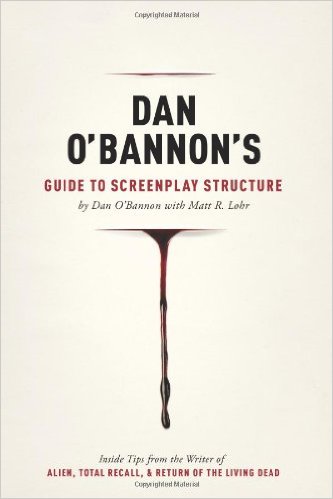
Released, sadly, after O’Bannon’s death in 2009, his Guide to Screenplay Structure was a book I was keen to read, coming from the mind of the man who had been instrumental in the development of some classic screen stories, such as ALIEN, DARK STAR and TOTAL RECALL. Regardless of the stories behind bringing ALIEN to the screen, I was intrigued to get inside the mind of O’Bannon and I wasn’t disappointed.
O’Bannon’s style is fairly relaxed and friendly and I enjoyed reading the book for that reason. I found it a lot less stuffy than some of the more “formal” screenwriting tomes I had waded through prior to this. Although he presents this book as an alternative to other screenwriting formulas, and is very open that this is his interpretation of how to write a screenplay, there are similarities between many of O’Bannon’s approaches and these other formulas. Indeed, in one chapter, where he gives his impression of other writers’ approaches, from Aristotle to Field and McKee, he is wise to acknowledge that there are links between all the different approaches and formula used in the screenwriting process.
A number of classic scripts, including Citizen Kane, Casablanca and Some Like it Hot, are also analysed, breaking each down into its component parts and exploring different aspects of the different approaches.
The book is full of exercises designed for the reader to explore some of the concepts and systems that O’Bannon discusses in each chapter.
Essentially, at the heart of the book, and O’Bannon’s writing, is conflict. He describes a screenplay as a fight and I liked his way of looking at it. Drama creates conflict and conflict should be at the heart of every story. When you boil your screenplay down, if it isn’t about conflict, then O’Bannon is not convinced it is even a story. And, while he talks about this a lot throughout the book, he also touches on classic aspects of screenwriting such as the 3-ACT Structure, exposition and screenplay length.
The one thing that really stuck with me after reading this book though was O’Bannon’s use of the Hedonic Adaptation Effect.
Put simply, this is about the way people react to extreme change or a prolonged situation (good or bad) through a dulling-down of the situation’s effects, allowing people to adapt to that change and the new world they are taken into. Within a film, this is closely linked to plot twists and turns and Horror is probably a good example of how this can be used to raise the stakes throughout the development of the plot.
Early on, a writer may introduce their monster via a shocking scene, jolting their character(s) out of a status quo, shaking up their complacency (very much like an inciting incident). As they adapt to this change, the writer may use this time to deliver some exposition and allow the audience to come to terms with what just happened and what is going on in the onscreen world. As soon as the characters and the audience have adjusted and become accustomed to this new, elevated reality, you can hit them with another twist/shock that bumps them up another level of awareness. And you keep doing this, ideally with more regular frequency, as you speed towards the story close, to keep raising the stakes, increasing the tension and delivering conflict through a series of revelatory shocks. You are, effectively, repeatedly lulling your audience into a false sense of security after a shock, before shaking things up in bigger and better ways.
To be honest, this is probably something that many screenwriters do already, but O’Bannon explains it all in a simple and informal way that, like the rest of his book, makes you feel he is telling YOU personally about his process. If you have been writing for years and read all “the other” books, then O’Bannon’s may not be a great revelation of “anything new” but it is a well written, easy to read exploration of some of the key aspects of screenwriting from the perspective of someone who knows how to write a screenplay. And it’s fun to read.
Highly recommended!



 Dark Mark Writing